Reading time: 5 minutes · Published: Jun 2025
M3 vs CPI: Which Measure Should You Trust?
If you follow South African economic news, you have seen the CPI inflation rate reported every month. But there is another number that often tells a different story: M3 money supply growth.
What CPI Actually Measures
The Consumer Price Index (CPI) tracks the price of a fixed basket of goods and services over time. Stats SA determines the basket, updates the weights periodically, and publishes a headline inflation rate. It is useful for:
- Understanding how consumer prices are changing
- SARB interest rate decisions (CPI targeting)
- Cost-of-living adjustments in salaries and grants
But CPI has limitations. It uses substitution effects, quality adjustments, and averaging. Your personal inflation - what you actually pay for rent, school fees, medical aid, transport, and food - can be very different from the headline number.
What M3 Money Supply Actually Measures
M3 is the total quantity of rands in the economy. It includes cash, bank deposits, and other liquid assets. It is not a price index. It is a quantity index. When M3 grows, there are simply more rands.
M3 is useful for:
- Understanding monetary dilution - the expansion of the rand pool
- Benchmarking whether your income or savings are keeping pace with money creation
- Seeing long-term trends that CPI may smooth over
Why They Diverge
CPI and M3 often move at different rates. M3 tends to grow faster than CPI over long periods in South Africa. The gap represents money that is created but has not yet pushed up consumer prices - or that flows into assets, property, and financial markets instead.
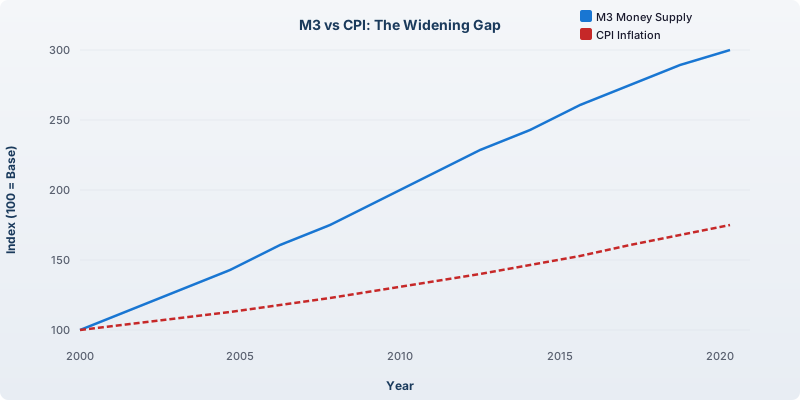
M3 Money Supply (blue) vs CPI Inflation Index (red), both indexed to 100 at the starting period. The widening gap shows monetary dilution that CPI does not capture.
Which One Should You Use?
The honest answer: both. They answer different questions.
- Use CPI for short-term cost-of-living adjustments and budgeting.
- Use M3 for long-term wealth, savings, salary, and asset comparisons.
If you only look at CPI, you may think you are doing fine when your purchasing power is quietly eroding. If you only look at M3, you may overestimate the immediate impact on your monthly budget. Together, they give a fuller picture.
View the interactive M3 vs CPI chart to see the comparison over time, or use the calculator to check specific amounts and dates.